
How to Search DeKalb County Criminal Records
A DeKalb County criminal records search starts with the Sheriff's jail portal for arrest and booking data, then moves to the court portal for the case file and disposition. The Sheriff's Office is led by Sheriff Melody M. Maddox, and the official site is dekalbsheriff.org. The county judicial portal at portal-gadekalb.tylertech.cloud covers Superior, State, and Magistrate court filings.
The District Attorney's Office at dekalbda.org prosecutes felonies. Sherry Boston is the District Attorney. The Solicitor-General handles many State Court misdemeanors.
The DeKalb District Attorney homepage is the official source for prosecution policy, diversion programs, and victim services.
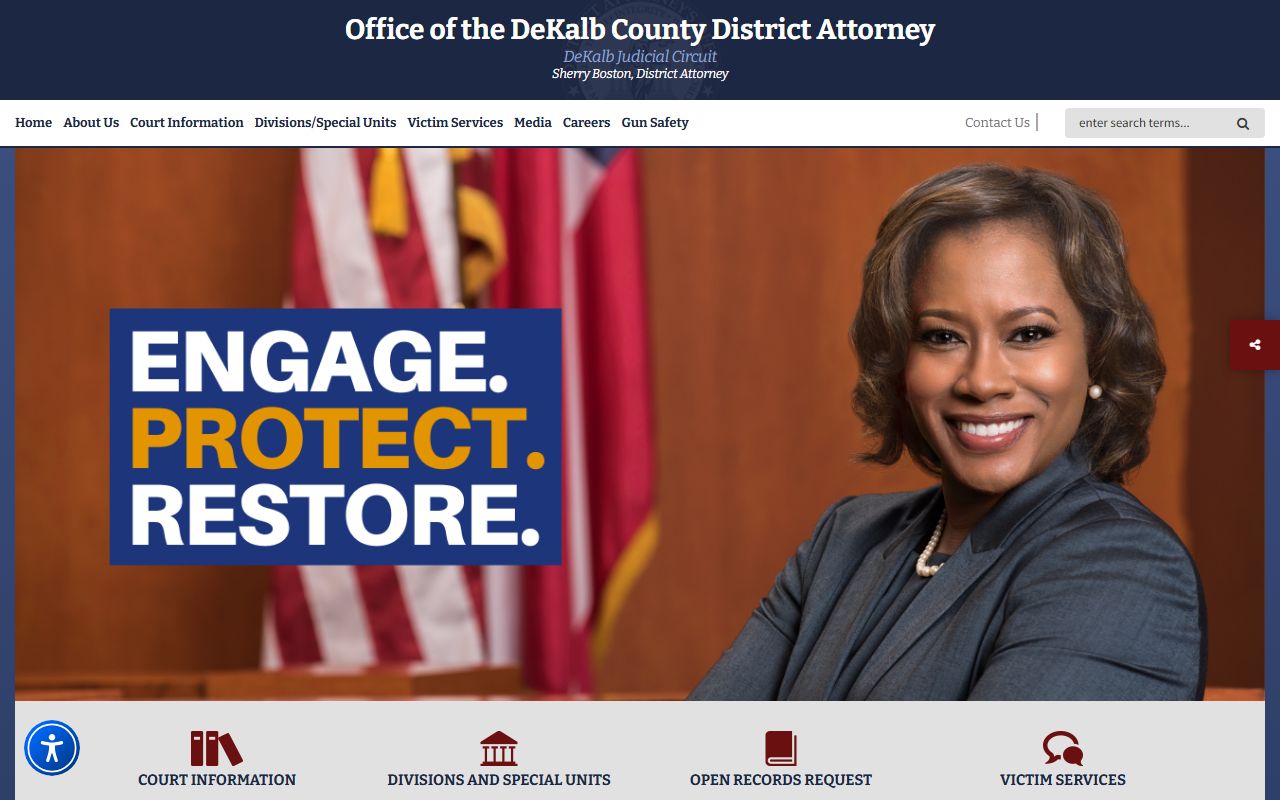
The DA site is the public face of felony prosecution in DeKalb. The office posts updates on diversion, accountability courts, and victim-witness assistance that affect public criminal records.
The Superior Clerk's criminal division indexes filed felony cases through the court portal and provides certified copies on request.
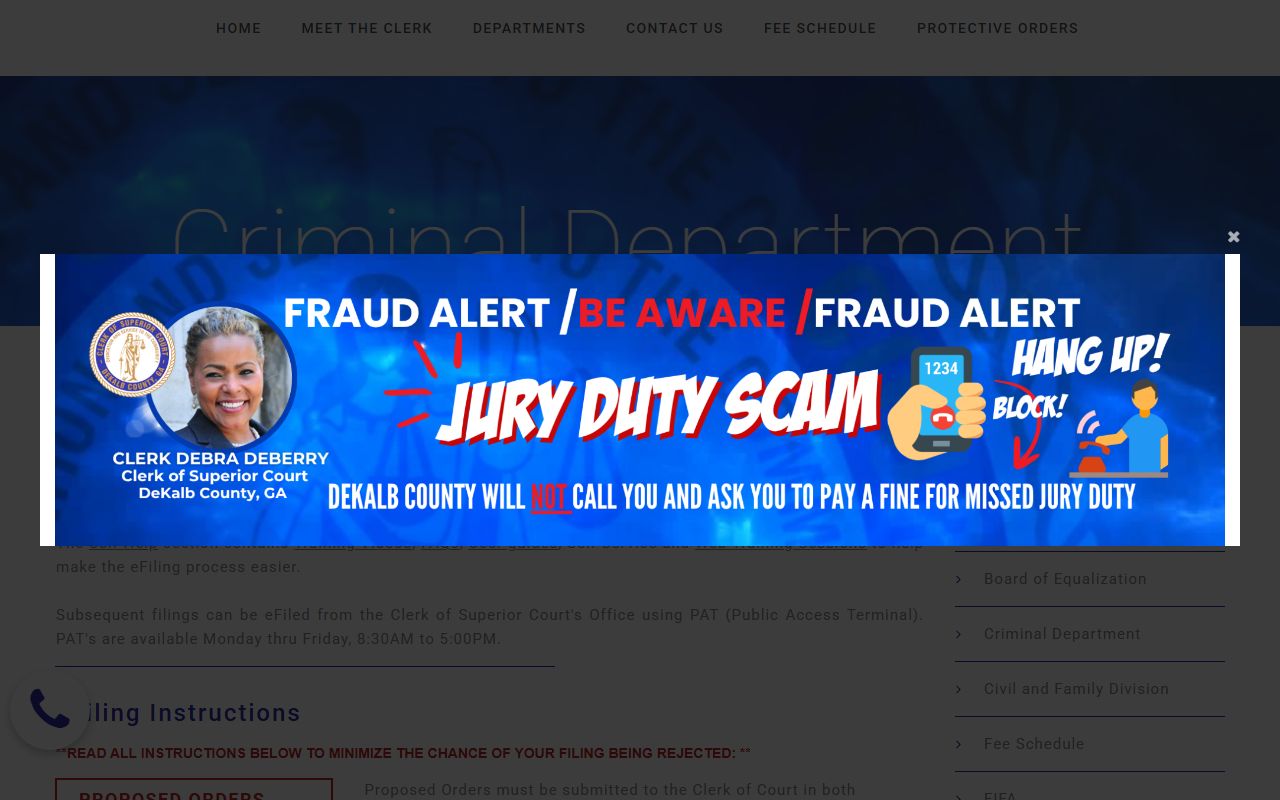
That page handles felony case copies, sentence orders, and other Superior Court criminal record requests.
The Four Layers of a DeKalb County Criminal Record
A single arrest can generate four different records, kept by four different offices. A user who pulls one layer and assumes it tells the whole story will often be wrong. The layers and their custodians are listed below.
- Police incident or arrest report: kept by the arresting agency. For Sheriff arrests, request from the Sheriff's open records office.
- Jail booking record: kept in the Tyler Jail Search system by the Sheriff. Shows booking, charges, bond, and release data.
- Court criminal case file: kept by the clerk of the court that owns the case. Felony files at the Clerk of Superior Court. Misdemeanor files at the State Court Clerk.
- Georgia criminal history: kept by the Georgia Bureau of Investigation under O.C.G.A. § 35-3-34. Dissemination is narrower than docket access.
An arrest can appear in the jail portal before an indictment exists in court. A court case can show a final disposition that does not yet appear in GBI criminal history. The disposition matters, not just the booking.
DeKalb Superior Court Felony Records
Felony cases in DeKalb County are filed and tried in Superior Court. The Clerk of Superior Court maintains the case file at 556 North McDonough Street, Decatur, GA 30030. Records typically include the indictment or accusation, arraignment, motions, plea or trial documents, sentence sheet, probation order, and any appeal notice. Civil collateral matters, such as forfeiture or restitution, may also appear on the docket.
The Smart Search portal returns felony case results when location is set to "DeKalb Superior Courts." The District Attorney prosecutes the case, and the public defender, retained counsel, or self-represented defendant appears for the defense. The Superior Court page covers the trial court more deeply, and the Clerk of Superior Court page covers certified copies.
DeKalb State Court Misdemeanor Records
State Court is the high-volume DeKalb misdemeanor court. Misdemeanor traffic, DUI, simple battery, theft by taking under the felony threshold, and other state-law misdemeanors filed in DeKalb often land in State Court. The State Court Clerk holds the case file. The Solicitor-General prosecutes State Court cases, separate from the District Attorney who handles felonies.
For State Court traffic specifically, see the traffic court records page. For State Court records and certified copies, see the State Court Clerk page. Magistrate Court issues warrants and runs first appearances, but the misdemeanor prosecution itself sits in State Court.
DeKalb Magistrate Court Warrants and First Appearances
Magistrate Court is the working entry point for many DeKalb criminal cases. Magistrate judges issue arrest warrants on a finding of probable cause, conduct first appearance hearings within statutory time limits, and set initial bond on misdemeanor and many felony matters. The court also handles preliminary hearings before a case is bound over to State or Superior Court.
A Magistrate first appearance is often the first court entry a defendant has. The judge advises the defendant of charges, sets bond when allowed, and orders any no-contact or other release condition. The Magistrate Court page covers the office's role in detail. The warrant records page covers warrant types and resolution.
District Attorney's Role in DeKalb Criminal Records
The District Attorney represents the State in Superior Court felony prosecutions. The office reviews arrests, presents cases to the grand jury when indictment is needed, files accusations when the law allows, conducts pretrial motions and trials, and recommends sentences. The DA also runs victim-witness assistance and diversion programs.
The DA can decline to prosecute, dismiss a case before filing, or move to nolle prosse a charge after filing. A nolle prosse is a decision to drop the charge, and a case may show that disposition on the docket. The Solicitor-General handles many State Court misdemeanors and works in a parallel role. Public defenders represent the financially eligible defendants. None of these offices issue certified criminal records. That route is the GBI.
DeKalb Public Defender Access
The Georgia Public Defender Council's DeKalb Judicial Circuit office provides indigent criminal defense for eligible defendants. The site is gapubdef.org/office/dekalb-judicial-circuit. Eligibility is determined by the court at first appearance or arraignment based on income and assets.
The DeKalb Public Defender office handles felony, certain misdemeanor, juvenile, and post-conviction matters where the law guarantees counsel. A defendant who cannot afford a private attorney should ask at first appearance or contact the office directly. The Public Defender does not handle civil matters.
The Georgia Public Defender Council page for DeKalb provides current contact information.
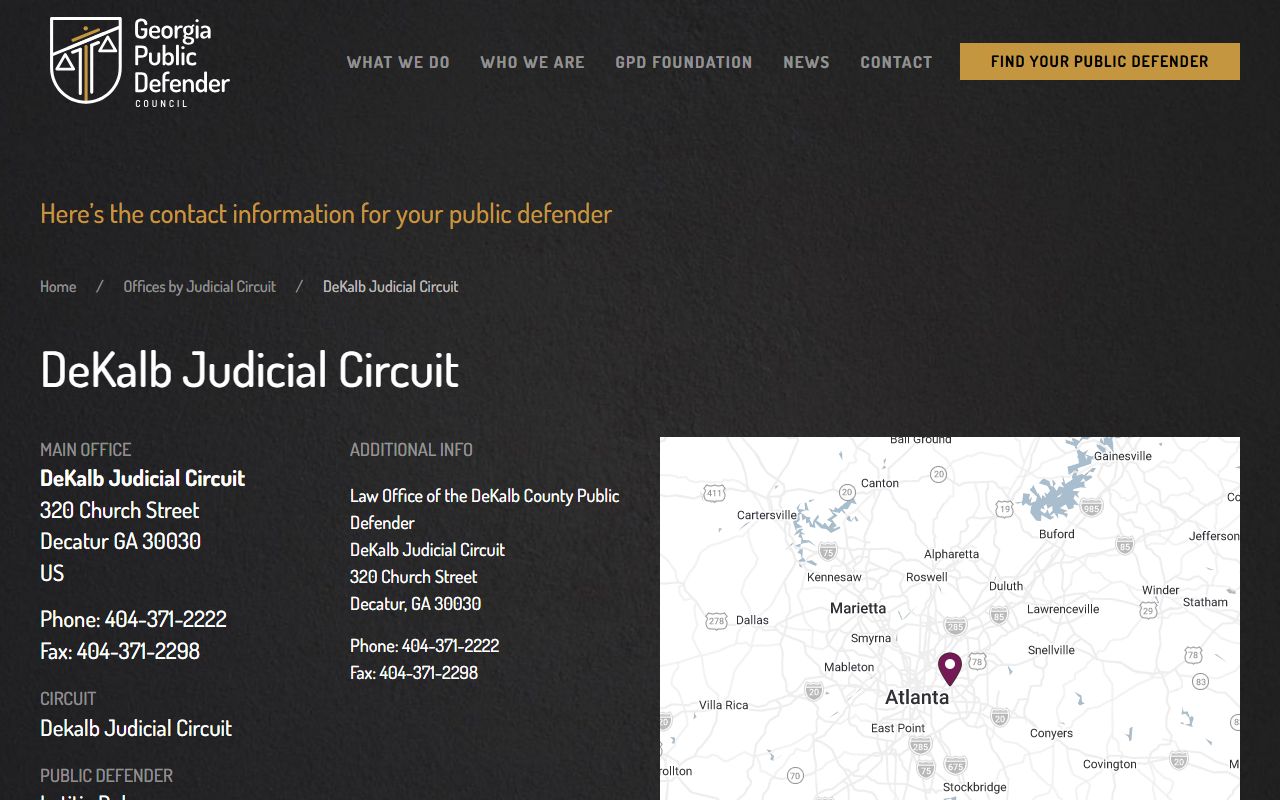
The Public Defender Council page is the right starting point for any DeKalb defendant who needs court-appointed counsel.
Record Restriction Under Georgia Law
Georgia uses the term "record restriction" rather than traditional expungement. O.C.G.A. § 35-3-37 allows certain arrests and a narrower set of convictions to be restricted from public criminal-history dissemination. Eligible categories include arrests that did not result in conviction, dismissed charges, nolle prosse, acquittals, and some specific convictions that meet statutory criteria after a waiting period.
The Georgia Bureau of Investigation explains the process at gbi.georgia.gov. Eligibility depends on offense, disposition, sentence completion, waiting period, and prosecutor objection. Record restriction is not automatic. A petitioner may need to apply through the arresting agency or file a petition in court, depending on the case age and the disposition.
The GBI record restriction page provides the official process and forms.
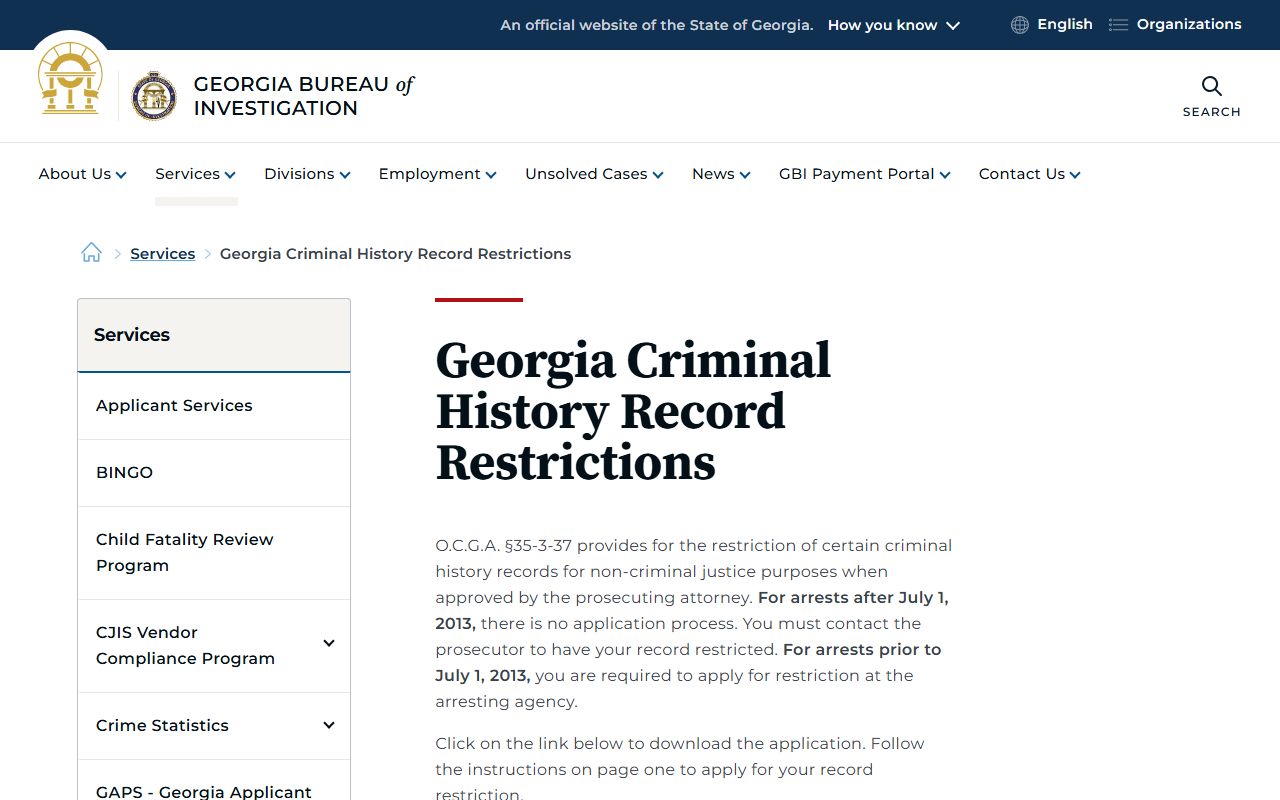
The GBI page covers eligibility, the petition process, and the difference between administrative restriction and court-ordered sealing.
Charges vs Convictions in DeKalb Criminal Records
An arrest or filed charge is not the same as a conviction. The table below explains the key differences for DeKalb cases.
| Charge | Conviction |
|---|---|
| An allegation by police or prosecutor. | A court's finding of guilt after plea or trial. |
| Shows in jail booking and court docket. | Shows on a court sentence sheet and in GBI criminal history when reported. |
| May be dismissed, nolle prossed, or reduced. | May still be appealed, vacated, or modified post-conviction. |
| Public information unless sealed. | Public unless restricted under § 35-3-37. |
| Cannot be used as proof of guilt. | Carries collateral consequences for employment, housing, licensing. |
Note: A jail booking with charges is not a conviction. Read the court disposition before drawing conclusions.
Sealed vs Expunged in Georgia
Georgia does not use a single "expungement" term. The table below explains the close-but-different concepts and how they appear in DeKalb records.
| Sealed | Record-Restricted |
|---|---|
| A court order removes the record from ordinary public inspection. | A statutory process under O.C.G.A. § 35-3-37 limits public criminal-history dissemination. |
| Requires a court order, often with findings. | May be administrative or petition-based, depending on the disposition. |
| Docket may show limited or no entry. | GBI criminal history report no longer shows the entry to most requesters. |
| Law enforcement and the court may retain access. | Law enforcement, prosecutors, and certain employers may retain access. |
| Private databases may not update. | Private databases may not update without a separate dispute. |
DeKalb Juvenile Record Confidentiality
Georgia juvenile records are confidential under O.C.G.A. § 15-11-700 et seq. Public search tools do not return juvenile case content. Parties, attorneys, the agencies involved, and certain authorized persons may access juvenile dependency, delinquency, child-in-need-of-services, and termination records. The DeKalb Odyssey portal does not surface juvenile case files in ordinary results.
A parent or guardian who needs access to a juvenile court record should ask the attorney of record or contact the court directly. The court will explain whether the record may be released, redacted, or remain sealed.
GBI Criminal History vs DeKalb Court Docket
A GBI criminal history report is a state-level product. It is built from arrests reported by law enforcement, charges filed by prosecutors, dispositions reported by courts, and sentence data reported by corrections. A DeKalb court docket is a single court's case file. The two are related but not the same. A DeKalb arrest can show in GBI history without a current court case. A DeKalb court disposition can take time to reach GBI.
For an official Georgia background check, a requester uses GBI's published process, not a portal screenshot. For a court-specific disposition, the case docket and a certified copy from the clerk are the right tools. For federal records, PACER and the Northern District of Georgia are the right starting points. For state corrections, the Georgia Department of Corrections offender query covers sentenced state prisoners.
How to Read a DeKalb Criminal Case Disposition
The disposition is the case outcome. Common DeKalb dispositions include guilty plea, guilty verdict, not guilty verdict, dismissal, nolle prosequi, first offender treatment, probation, and sentence imposed. Each carries different consequences for the defendant and for record restriction eligibility.
"Final Judgment and Decree" usually closes the case. "Sentence" indicates conviction with imposed punishment. "Dismissed" or "Nolle Prosse" indicates the prosecution ended without conviction. "Reopened" or "Reopen - Bench Warrant" can indicate post-judgment activity. Read the date, the docket entry, and any attached order before drawing conclusions.
Common Reasons a DeKalb Criminal Records Search Comes Back Empty
An empty result is not legal proof a case does not exist. The list below covers the most common causes.
- Name misspelling or use of a maiden name not yet indexed.
- City municipal court case, not county State Court.
- Sealed, restricted, or juvenile record.
- Older paper file not in the online portal.
- Federal case in Northern District of Georgia, not county court.
- Pending filing not yet docketed by the clerk.
- Wrong case-number format or wrong court location selected.
- CAPTCHA or session timeout during the search.
Note: A clerk request is the right next step when the online portal returns nothing on a known case.