
How to Search DeKalb County Court Records
The main public tool is the Odyssey Portal Smart Search, branded as the DeKalb County Judicial Information System. It is built on Tyler Technologies' Odyssey court software. Smart Search covers cases filed in DeKalb Superior Court, DeKalb State Court, and DeKalb Magistrate Court. The default scope is "All Courts," but the location filter can narrow a search to just the Superior Courts or just the State and Magistrate Courts. The portal looks up case dockets, party names, citation numbers, and attorney filings. It does not search warrants, judgments, or protection orders. Anonymous users must clear a reCAPTCHA before each search.
Before starting a search, gather what you know. A case number returns the cleanest result. A full name in Last, First Middle Suffix format works too. Common names will return many hits, so plan to filter by file date or court type.
The image below shows the DeKalb County Judicial System landing page, which links out to every trial court and clerk in the county.
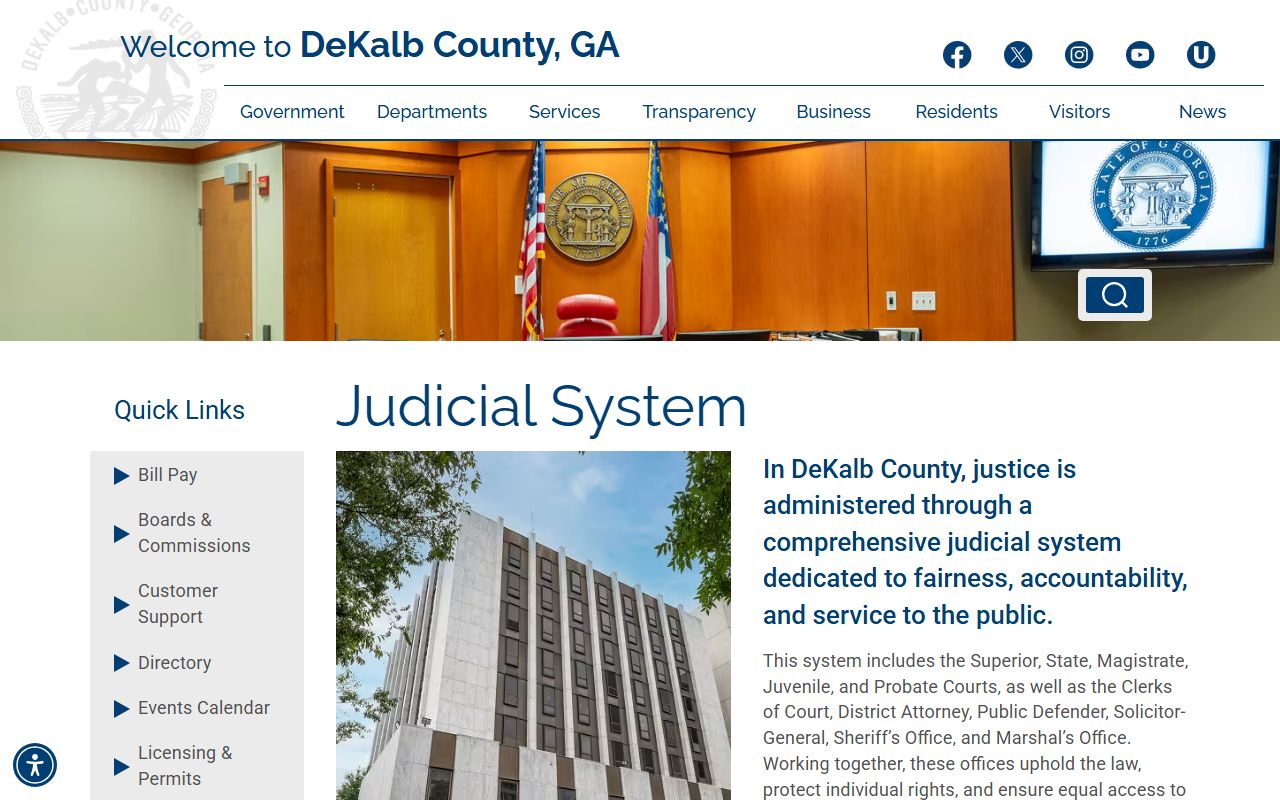
That page is the cleanest jumping-off point for visitors who do not yet know which court holds their case. From there a user can click through to the Clerk of Superior Court, the State Court Clerk, or the Probate Court site.
- Open the Odyssey Portal and choose Smart Search from the dashboard.
- Leave the location set to All Courts if you are not sure which court holds the case. Pick DeKalb Superior Courts for a felony, divorce, or major civil file. Pick DeKalb State and Magistrate Courts for a misdemeanor, traffic citation, small claim, or eviction.
- Type the record number or the name. Use Last, First Middle Suffix format. A wildcard search needs at least four characters on a case number, or at least three last-name letters plus a star and one first-name letter plus a star.
- Open Advanced Filtering Options if the name is common. Narrow by case type, case status, file date range, or judicial officer.
- Pick Search Type if you want to search by attorney bar number, business name, citation number, judicial officer, nickname, or party name.
- Complete the CAPTCHA box and click Submit.
- Read each result by case number, caption, court location, filing date, and status. Document images and detail pages may be limited by access level, payment, or record restriction.
For docket-only questions about an upcoming hearing, use Search Hearings instead. That tool surfaces hearing date, courtroom, judicial officer, and hearing type. The same login and CAPTCHA rules apply.
Smart Search Field Reference
The portal exposes a long list of inputs. The table below pulls out the most useful ones. Most of these fields appear after you click Advanced Filtering Options.
| Field | Type | Notes |
|---|---|---|
| Record Number or Name | Text | Up to 100 characters. Accepts case number, name, business name, or wildcard. |
| Filter by Location | Dropdown | All Courts, DeKalb State and Magistrate Courts, or DeKalb Superior Courts. |
| Filter by Search Type | Dropdown | Smart Search, Attorney Bar Number, Attorney Name, Business Name, Case Cross-Reference Number, Case Number, Citation Number, Judicial Officer, Nickname, or Party Name. |
| Filter by Case Type | Dropdown | All Case Types, Civil, Criminal, Family, or grouped Civil and Family. |
| Filter by Case Status | Dropdown | Open, Active, Pending, Closed, Dismissed, Reopened, Transferred, Warrant Issued, Sentence, Nolle Prosse, and others. |
| File Date Start / End | Date pickers | MM/DD/YYYY format. Use to narrow by filing window. |
| Judicial Officer | Dropdown | Active and past DeKalb judges. Useful when the assigned judge is known. |
| CAPTCHA | reCAPTCHA | Required for anonymous users on every Smart Search. |
Note: A docket sheet pulled from Smart Search is informational only and is not a certified copy.
The DeKalb County Judicial System
DeKalb runs its own judicial circuit. The county is large, urban, and busy, so the court load is split by subject matter rather than packed into a single court. Superior Court is the anchor trial court. State Court is the second trial court and is unusually active here because traffic and misdemeanor volume is high. Magistrate Court is the entry point for small claims, evictions, warrants, and first appearances. Probate Court handles estates plus marriage and weapons carry licenses. Juvenile Court handles dependency, delinquency, and child protection. Each level has its own clerk and its own filing route.
Appeals from the trial courts move up to the Court of Appeals of Georgia. From there, some cases reach the Supreme Court of Georgia by certiorari. The Supreme Court has direct jurisdiction over certain constitutional, death penalty, and election matters.
The screenshot below is from georgiacourts.gov, the statewide judicial branch site that explains how the courts fit together.
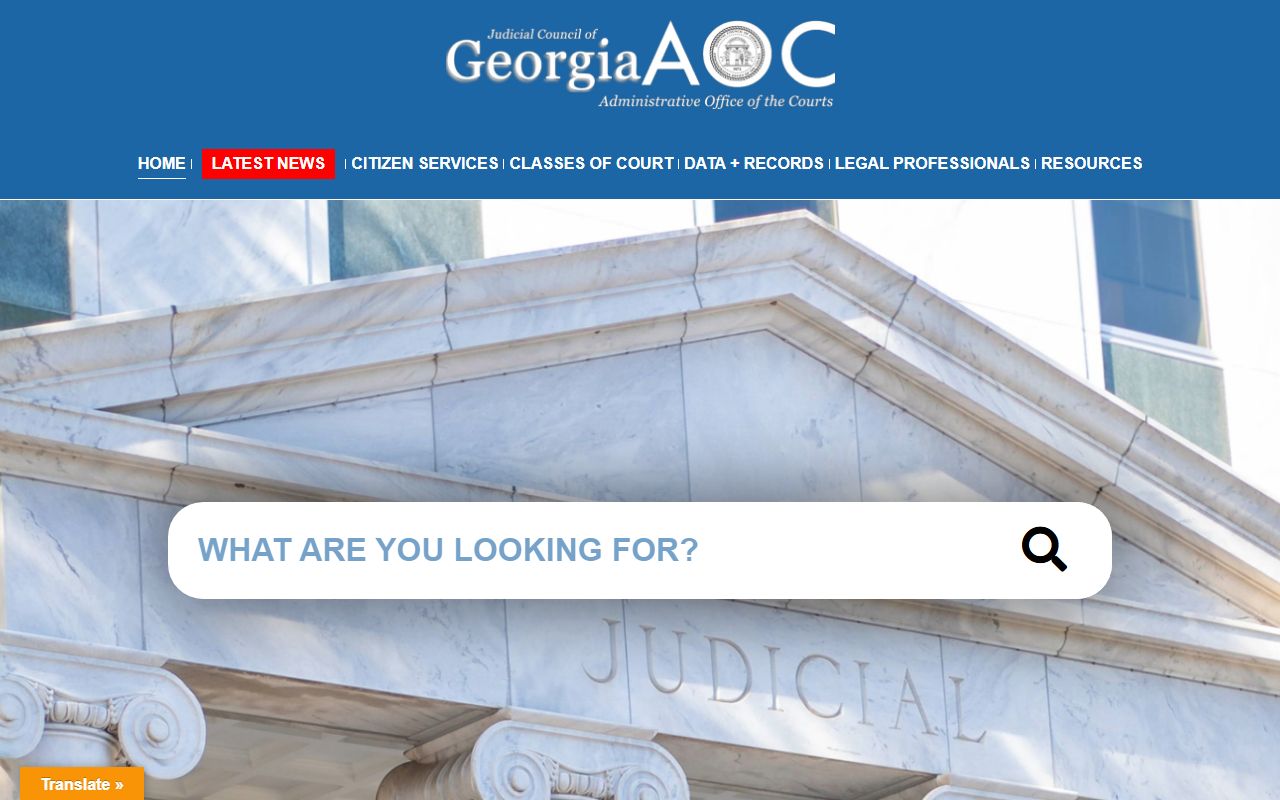
The statewide site is helpful for context. DeKalb-specific filings, dockets, and clerk services still route through county portals.
Case flow: Magistrate Court › State Court or Superior Court › Court of Appeals of Georgia › Supreme Court of Georgia.
| Court | Jurisdiction | Case Types |
|---|---|---|
| Superior Court | General trial | Felony, divorce, equity, title to land, major civil, family. |
| State Court | Limited trial | Misdemeanor, traffic, DUI, civil damage cases. |
| Magistrate Court | Limited trial | Small claims, dispossessory, garnishment, warrants, first appearance. |
| Probate Court | Limited trial | Estates, guardianship, marriage licenses, weapons carry licenses. |
| Juvenile Court | Limited trial | Dependency, delinquency, CHINS, termination. Records are restricted. |
| Municipal Courts | City-level | City ordinance and city traffic for Decatur, Dunwoody, Brookhaven, Tucker, and others. |
| Court of Appeals of Georgia | Appellate | Most civil and criminal appeals from the trial courts. |
| Supreme Court of Georgia | Highest state | Constitutional questions, death penalty, election, and discretionary review. |
The image below shows the Supreme Court of Georgia home page. It is the top of the appellate chain for cases that move out of DeKalb.
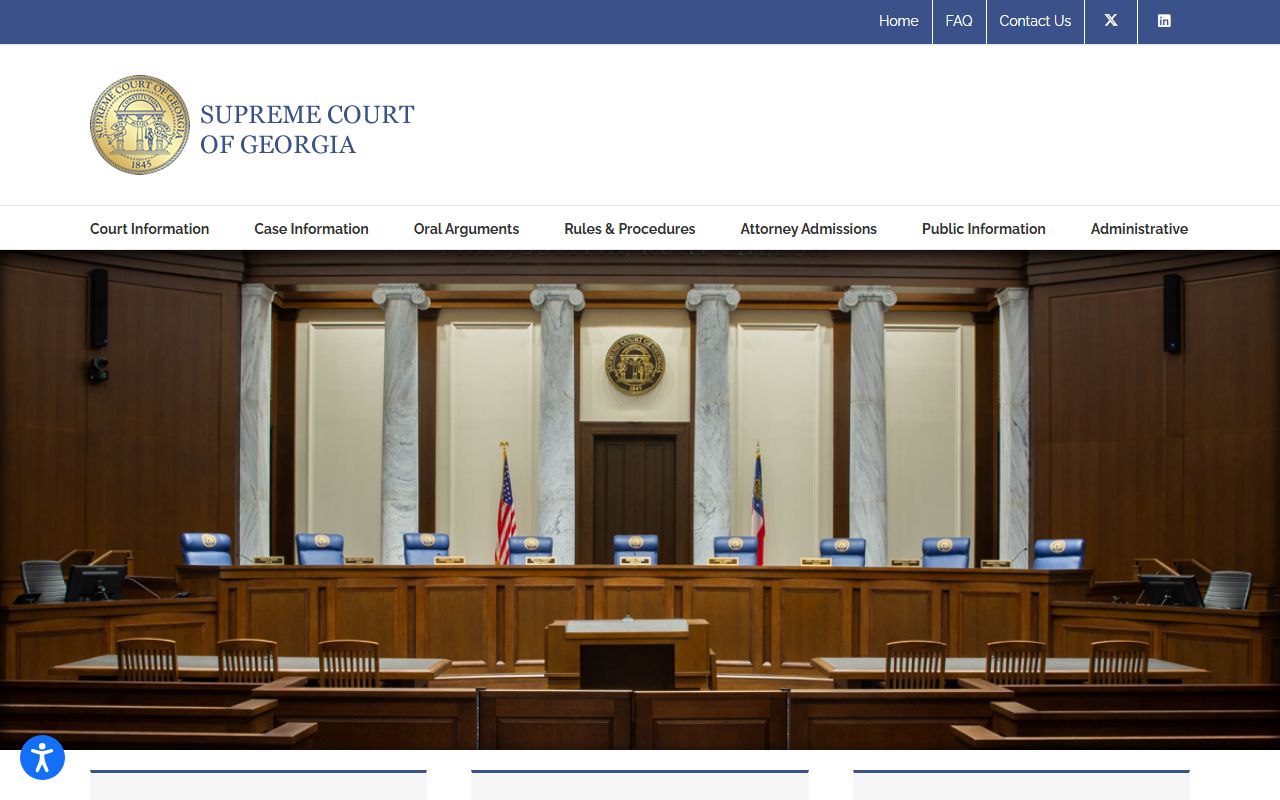
Most DeKalb cases never go this far. Appeals from the trial level land first at the Court of Appeals.
DeKalb County Courthouses
The county court hub is the DeKalb County Courthouse at 556 North McDonough Street in Decatur. Superior, State, Magistrate, and Probate Courts all operate out of the same downtown judicial complex. The county jail is on Memorial Drive, a short drive east of the courthouse. Each office below has its own counter, hours, and request rules.
DeKalb County Courthouse
556 North McDonough Street
Decatur, GA 30030
Superior, State, Magistrate, and Probate Courts
DeKalb County Jail
4415 Memorial Drive
Decatur, GA 30032
Sheriff's Office and detention
DeKalb Probate Court
556 North McDonough Street
Decatur, GA 30030
Estates, marriage, weapons carry
The image below is the DeKalb County government home page, which links to every court office and to the Sheriff.
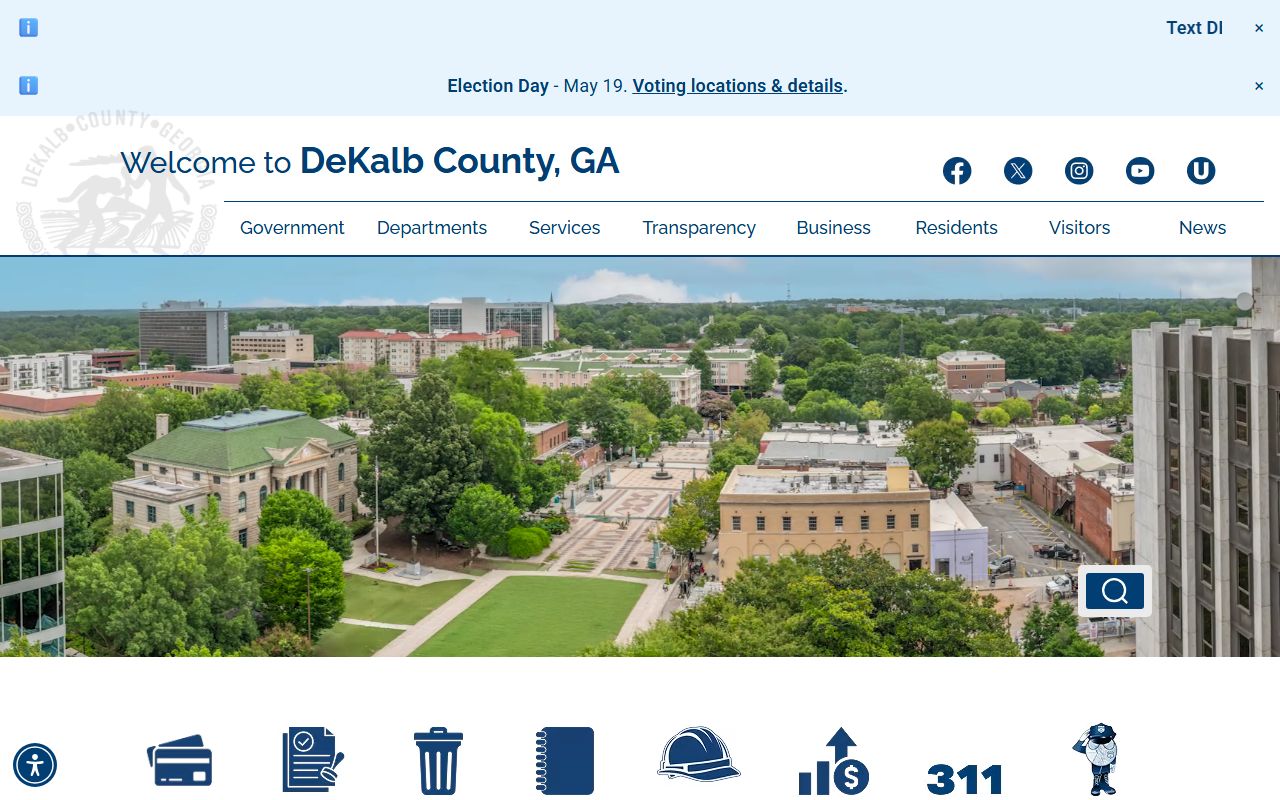
This is the right starting page when you do not yet know which court or office holds the file you need.
Types of Court Records Available in DeKalb County
The county courts produce a wide range of files. Some are felony case files held by the Clerk of Superior Court. Some are traffic and misdemeanor files held by the State Court Clerk. Magistrate Court keeps a separate set for warrants and small civil claims. Probate Court keeps its own estate, guardianship, and marriage files. Juvenile records are not part of the public search at all.
The list below covers the main record types and which court keeps them.
- Criminal records - Felony files in Superior Court; misdemeanor files in State Court. Magistrate keeps warrants and first-appearance entries. See DeKalb arrest records.
- Civil records - Tort, contract, equity, and major money cases sit in Superior Court. State Court handles smaller civil damage suits. Magistrate Court keeps small claims.
- Family and divorce records - Divorce, custody, child support, and protective orders are Superior Court files. See marriage and divorce records.
- Probate records - Wills, estates, guardianships, conservatorships, marriage licenses, and weapons carry licenses. See DeKalb probate records.
- Traffic records - State Court handles county traffic citations. City municipal courts handle citations issued inside city limits.
- Juvenile records - Dependency, delinquency, and child protection. Restricted by Georgia statute.
- Court dockets - Hearing calendars and filing logs. See DeKalb court dockets.
What DeKalb County Court Records Show
A court record is more than a name and a case number. It holds a full timeline of filings, hearings, motions, and orders. The fields in the table below appear on most Odyssey docket sheets. Some details are visible to the public. Some are restricted, sealed, or redacted.
| Field | What It Shows |
|---|---|
| Case Number | The court-coded ID. Format varies by court and case type. Often includes the filing year. |
| Court / Location | Superior, State, Magistrate, Probate, Juvenile, or a municipal court. |
| Filing Date | The date the case was opened on the court's books. |
| Parties | Plaintiff and defendant, state and defendant, petitioner and respondent, or decedent and heirs. |
| Charges / Cause | The criminal charge code or the civil cause of action. |
| Disposition | The outcome: dismissed, guilty, not guilty, nolle prosequi, judgment, or transferred. |
| Sentence / Judgment | Jail time, probation, fine, restitution, or money judgment if entered. |
| Judicial Officer | The assigned judge, magistrate, or senior judge. |
| Docket Events | Motions, orders, hearings, continuances, pleas, and final judgments by date. |
| Financial Fields | Bond amount, fines, costs, restitution, judgment principal, payments, and satisfaction. |
Redactions are common. Social Security numbers, bank account numbers, minor names, medical details, sealed exhibits, and protected victim data are removed from the public view. Document images may need a login, a fee, or a clerk request.
Public Access Laws for DeKalb County Court Records
Georgia treats most court records as public. The Georgia Open Records Act sets the rule for agency records. Court records follow that act plus common-law open-court principles and court-specific sealing rules. The default is that a filed pleading is open unless a statute or a judge says otherwise.
Requests to a court go to the clerk that holds the file. Requests to the Sheriff, the DA, or a county agency go to that agency's open-records officer under the Open Records Act. Agencies must respond within three business days. Fees are tied to actual search, retrieval, redaction, and copy time. Georgia uses the term "record restriction" instead of expungement, and eligibility is set by statute.
Key Statutes:
O.C.G.A. § 50-18-70 - Sets the public right to inspect government records and defines what counts as a public record in Georgia.
O.C.G.A. § 50-18-71 - Sets the three-business-day response window and the rule that copy fees must match actual search and retrieval costs.
O.C.G.A. § 50-18-72 - Lists exemptions, including law-enforcement, medical, attorney work product, and trade secret records that may be withheld.
O.C.G.A. § 35-3-37 - Sets the record-restriction process for eligible Georgia arrests and some convictions.
Other rules also matter. Uniform Superior Court Rule 21 governs sealing of court files. Sealing needs a judge's findings, not an informal request. Juvenile, adoption, and grand jury records are restricted by separate statutes.
Records That Are Restricted or Confidential
Not every court record is open to the public. Several categories are protected by statute, by court rule, or by a sealing order. Juvenile dependency, delinquency, CHINS, and termination files are restricted under Title 15, Chapter 11 of the Georgia code. Adoption files are sealed under O.C.G.A. § 19-8-23. Grand jury proceedings stay confidential even after an indictment is filed. Medical and mental-health records inside a court file are usually redacted or sealed.
To view a sealed record, a person normally needs a court order. The petition is filed with the court that holds the case. The judge weighs the public interest against the privacy interest before granting access. Some cases let only a party, an attorney of record, or an authorized agency see the file. A person whose record was restricted under O.C.G.A. § 35-3-37 may still appear in some law-enforcement, prosecutor, or licensing-board databases.
Victim addresses, child victim names, sexual offense details, and protective-order safety data are routinely withheld. Trade secrets and proprietary business data can also be protected when statutory requirements are met.
Specialty Courts in DeKalb County
DeKalb runs problem-solving programs through its Superior and State Courts and through the District Attorney's office. These accountability calendars are for defendants whose cases involve substance use, mental illness, or other treatable drivers. Eligibility is set by the judge and the prosecutor. Violent offenses are usually not eligible.
Drug court combines judicial monitoring, treatment, random drug testing, case management, sanctions, incentives, and a graduation goal. Mental health and behavioral health calendars work the same way for eligible defendants with a diagnosed treatment need. The DeKalb DA also runs a separate diversion program. Diversion is prosecutor-run, not court-run. It lets an eligible defendant earn dismissal or a reduced charge by completing counseling, restitution, education, community service, or treatment.
Specialty court rosters change with grant funding and administrative orders. Verify the current program list with the court or the DA before relying on past information.
DeKalb County Sheriff and Jail
The DeKalb County Sheriff's Office runs the county jail at 4415 Memorial Drive in Decatur. Sheriff Melody M. Maddox heads the agency. The Sheriff's site at dekalbsheriff.org covers visitation, mail, commissary, warrants, and civil process. The District Attorney is Sherry Boston, and the DA's office at dekalbda.org prosecutes felony cases in Superior Court.
The public can search jail records through the Tyler Jail Search app. The tool indexes historical jailings, not just current custody. A name that returns a hit might be a release from years ago. For current details, visit the DeKalb County inmate records page. For active warrants, visit the warrant records page. Active-warrant search is not available through Smart Search; the public Odyssey portal has warrant search disabled.
Note: A Tyler Jail Search hit is not proof of current custody, and an empty search result is not proof of a clean warrant record.
Marriage, Divorce, and Probate Court
Marriage licenses are issued by DeKalb County Probate Court. Divorce decrees are Superior Court records and are held by the Clerk of Superior Court. Certified copies of a divorce decree come from the Clerk of Superior Court, not from Probate Court and not from the state vital records office. See marriage and divorce records and probate records for the full process.
Probate Court also handles estate filings, guardianships, conservatorships, and weapons carry licenses. The court uses its own forms and its own fee schedule. Some guardianship and conservatorship files have restricted access because they cover minors, medical decisions, or mental-health matters.
- Testator
- The person who makes a will.
- Executor
- The person named in a will to settle the estate.
- Conservator
- A person appointed by Probate Court to manage another adult's money or property when that adult cannot do so.
- Letters Testamentary
- The Probate Court order that gives an executor legal power to act for the estate.
- Year's Support
- A Georgia petition that lets a surviving spouse or minor child take a portion of an estate ahead of other creditors.
- Guardian
- A person appointed to make personal or medical decisions for a minor or an incapacitated adult.
DeKalb County Court Records Fees
Each clerk in DeKalb sets fees through the current schedule on its own site. The Clerk of Superior Court at dksuperiorclerk.com handles fees for Superior Court files, real estate, notary, and passports. The State Court Clerk handles fees for State Court files. Probate Court runs its own fee table. The Odyssey portal itself is free to search, but a certified copy or a full document image often costs extra.
| Item | Amount |
|---|---|
| Plain copy per page | Verify current fee with the Clerk of Superior Court |
| Certified copy per page | Verify current fee with the Clerk of Superior Court |
| Certification fee | Verify current fee with the Clerk of Superior Court |
| Records search fee | Verify current fee with the Clerk of Superior Court |
| Exemplified copy | Verify current fee with the Clerk of Superior Court |
| Civil filing fee | Set by case type; check current Superior, State, or Magistrate fee schedule |
| Real estate recording | Verify with the Real Estate division of the Clerk of Superior Court |
Statutory fee authority for the Clerk of Superior Court sits in O.C.G.A. § 15-6-77. The actual dollar amounts are published in the clerk's posted schedule, which changes from time to time. Online portal records are not a substitute for a certified copy in court, in probate, or for an immigration matter.
How to Interpret DeKalb County Court Records
A docket sheet uses short codes. Filing dates, status codes, and event tags can be hard to read at first. A few common terms show up on almost every record. Plaintiff means the party who sued. Defendant means the party sued or charged. Petitioner and respondent are the labels in family and probate cases. Disposition is the case outcome. Nolle prosequi means the prosecutor chose not to go forward on a charge. Dismissed with prejudice means the case cannot be refiled on the same claim. Final judgment is the binding end of a civil case.
An arrest does not equal a conviction. A case may be dismissed, nolle prossed, diverted, pled, tried, sentenced, or restricted. The disposition field is the one that matters for background checks. A bond field shows a release condition, not a final result. A warrant issued status flag is a hold for failure to appear or for a probation violation. A sentence field lists jail time, probation, fines, restitution, or community service.
For criminal records pulled outside the court system, the Georgia Crime Information Center at the Georgia Bureau of Investigation runs the statewide rap sheet. That file is not the same as a court docket. The court docket shows what the court did. The state file shows what the arresting agency reported.
Accuracy and Record Limitations
The Odyssey portal and the Tyler Jail Search both pull from the clerk's case management system. Updates happen on a routine cycle, but exact timing is not published. A new filing may not appear right away. A recent disposition may take a day or two to post. A booking may show up after the booking process is fully closed out. Sealed and restricted records may not appear at all.
Older paper-only files are not always scanned in. A case from the 1980s or 1990s may need a manual clerk request. Some older real estate, civil, and felony records sit on microfilm. The clerk's office can pull these but it can take days.
Note: Before acting on a court date, a warrant, a custody status, or a certified record, confirm the detail with the clerk or jail that holds the file.
History of DeKalb County Courts
DeKalb County was created in 1822. Decatur became the county seat and has held that role since. The courthouse square was the center of legal practice in the early years and remains the practical center today. Atlanta's growth east and south reshaped the county. Suburbs filled in. Cities such as Brookhaven, Chamblee, Clarkston, Doraville, Dunwoody, Lithonia, Pine Lake, Stone Mountain, Stonecrest, and Tucker incorporated and added municipal courts of their own.
The court system itself evolved. Superior Court has long been the general-jurisdiction trial court. State Court grew into a high-volume traffic and misdemeanor court because of population and traffic density. Magistrate Court became the entry point for small civil claims, evictions, garnishments, warrants, and first appearances. Probate Court's public-facing work now includes estates, marriage licenses, and weapons carry licenses. The Odyssey portal, run on Tyler Technologies' system, created a single public search across the Superior, State, and Magistrate trial courts. That was a major step for public record access.
Appeals from DeKalb County Courts
A decision from a DeKalb trial court can be appealed. Most appeals from Superior Court and State Court go to the Court of Appeals of Georgia. Some matters move directly to the Supreme Court of Georgia. The Court of Appeals reviews the trial court record and issues a written opinion. From there, a losing party may ask the Supreme Court for certiorari.
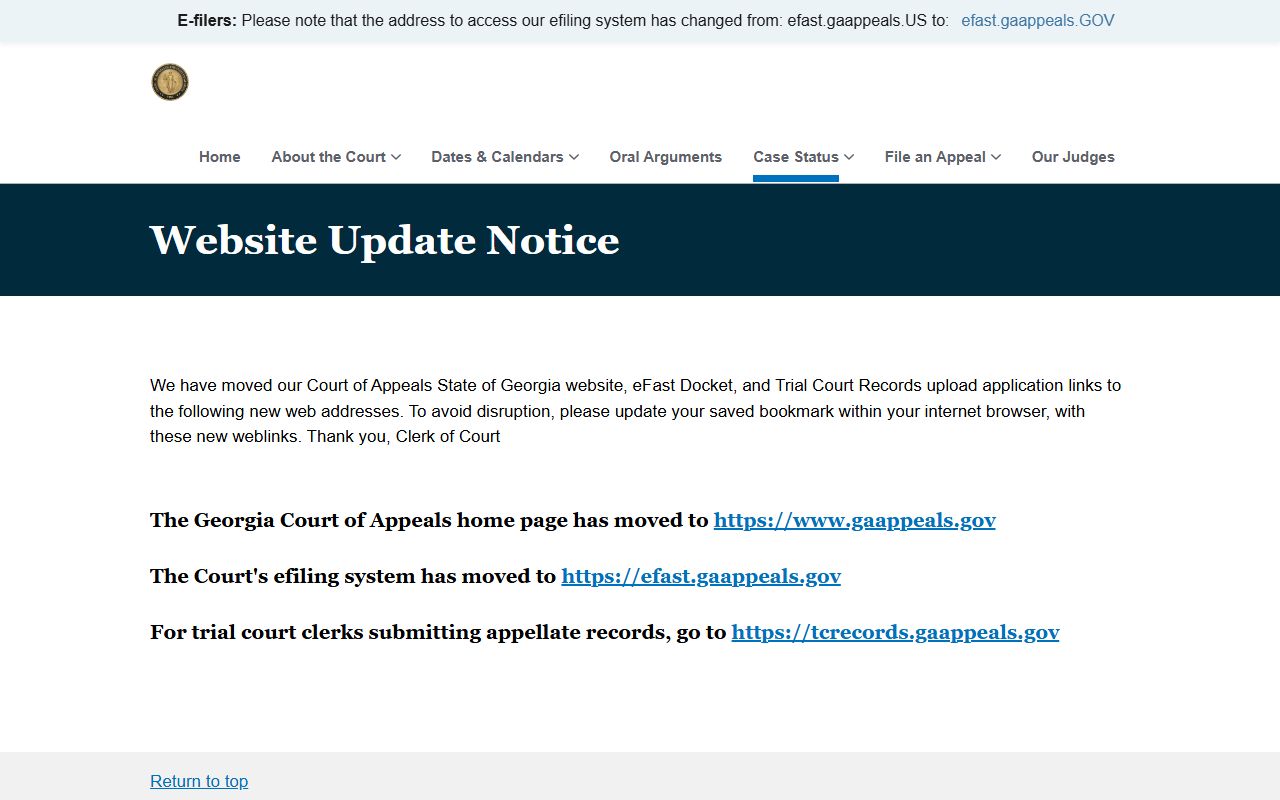
The image below shows the Court of Appeals of Georgia home page, which links to oral argument calendars, opinions, and clerk contact information.
An appeal does not work as a second trial. The reviewing court looks at the record made in the trial court and the legal arguments raised on appeal.
Self-Help and Legal Aid in DeKalb County
Free and low-cost help is available for people who cannot afford a lawyer. Georgia Legal Aid offers statewide civil legal information, forms, and referrals. Atlanta Legal Aid Society serves eligible low-income clients in DeKalb for housing, family, benefits, and consumer matters. The Georgia Public Defender Council DeKalb office represents indigent defendants in criminal cases where liberty is at stake. The Georgia Justice Project focuses on criminal-record restriction and reentry. The State Bar of Georgia runs a lawyer referral service. The DeKalb Law Library supports legal research for self-represented litigants.
Pro se litigants commonly need help with divorce, fee waiver and pauper affidavits, dispossessory answers, small claims, garnishment, name change, probate, record restriction, and protective order petitions. Parties needing an interpreter or a disability accommodation should contact the court well before the hearing date, not the morning of court.
Other DeKalb County Public Records
The court files are only part of the county's public record set. The Clerk of Superior Court Real Estate division keeps deeds, mortgages, plats, liens, and notary commissions. The Sheriff's Office keeps incident reports, jail logs, and civil process records. The DA keeps prosecution files and victim services records. Many of these are open under the Georgia Open Records Act. See DeKalb County public records for the full request process.
The county also keeps tax assessments, business filings, building permits, code enforcement actions, and budget documents at the county level. Each agency has its own open-records officer. A request should name the records sought, the date range, and the format. Fees may apply for staff time and copies.
Frequently Asked Questions
How do I search DeKalb County court records online?
Use the Odyssey Smart Search portal at portal-gadekalb.tylertech.cloud. Enter a case number, citation number, party name, business name, attorney name, or other identifier. If the name is common, open Advanced Filtering Options and narrow by court location, case type, status, file date, or judicial officer. Anonymous users must complete a CAPTCHA. The portal is free to search. Certified copies still come from the clerk that holds the record.
Which court handles felony cases in DeKalb County?
Felony cases are heard in DeKalb County Superior Court. Magistrate Court may issue the warrant, set bond, and handle the first appearance. After that, the case is bound over to Superior Court for indictment, plea, trial, and sentencing. The District Attorney prosecutes felony cases. The Clerk of Superior Court keeps the official felony case file.
How do I find a DeKalb inmate?
Use Tyler Jail Search at portal-gadekalb.tylertech.cloud/app/JailSearch. Enter at least three characters of a name. Results show the defendant's name, SO number, booking number, facility, booking date, release date, arresting agency, and charges. Click View Jailing for the full detail page. The tool also indexes historical jailings, so a hit might not reflect current custody. See DeKalb inmate records for the full walkthrough.
More on the DeKalb County Court Records FAQ page.