
How to Search DeKalb County Warrants
The Sheriff's Office is the lead agency on warrant execution and is the right starting point. The official site is dekalbsheriff.org, and the warrants page is dekalbsheriff.org/warrants. Magistrate Court issues most arrest warrants on a finding of probable cause. State or Superior Court judges issue bench warrants when defendants miss court or violate orders.
The county judicial portal at portal-gadekalb.tylertech.cloud does not include a complete warrant search. The Smart Search settings have warrant search disabled in the public configuration. Reading a court docket may show a warrant-related entry, but the docket is not a substitute for a warrant unit confirmation.
The Sheriff's Office is the official source for warrant resolution and contact.
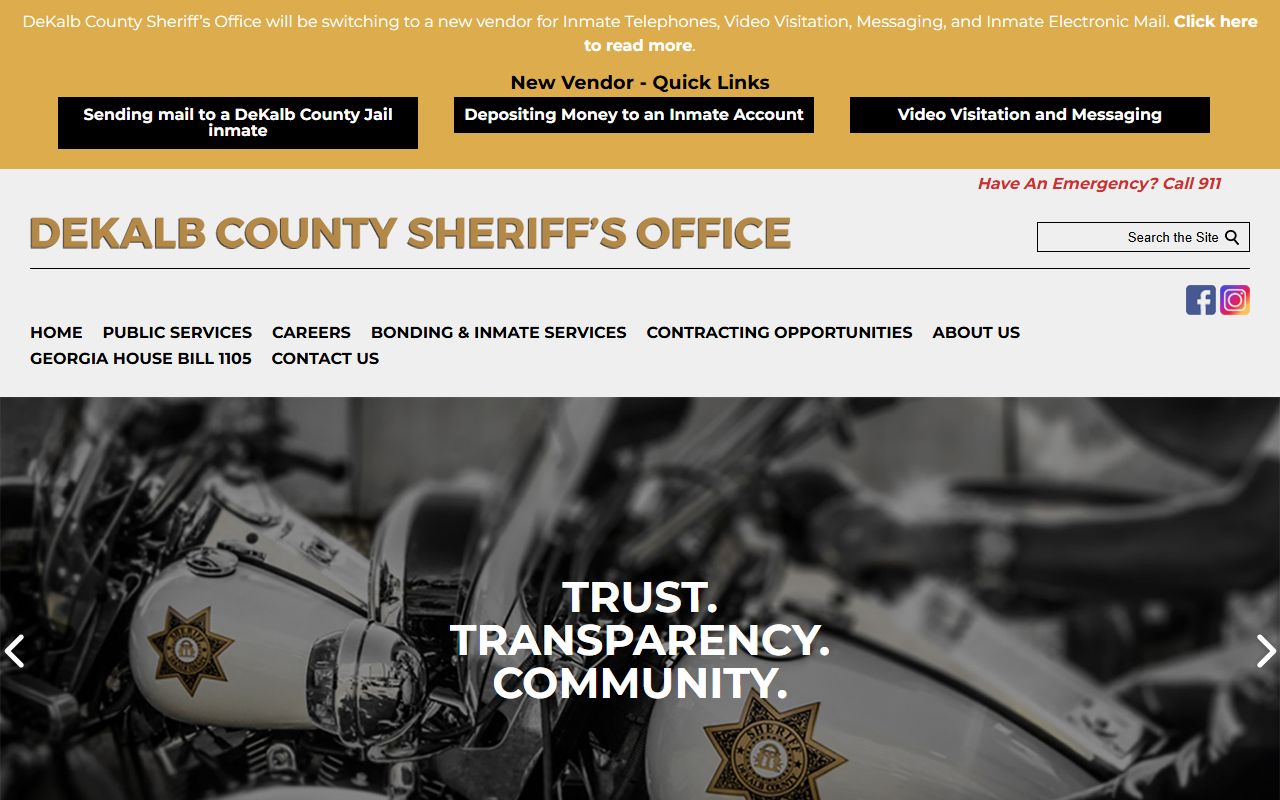
The Sheriff's homepage links to the warrant unit, jail, civil process, and inmate services. It is the agency directory for any warrant question that the court clerk cannot answer.
Why DeKalb Has No Single Warrant Database
A full public active-warrant search portal would surface sealed warrants, search warrants, and fugitive holds that the courts and law enforcement intentionally protect. Search warrants are not public before execution. Sealed warrants stay confidential pending court action. A complete public list would also tip off subjects who may flee, threaten witnesses, or destroy evidence.
The inspected Smart Search settings show SearchWarrantsEnabled as false. The Sheriff's site provides contact information and a path to verification rather than a full database. The Magistrate Court's role in issuing warrants is part of the public process, but its records do not include a single live active-warrant list either. The honest answer: a DeKalb County warrant search needs human verification, not a single online portal.
Types of Warrants in DeKalb County
DeKalb courts and the Sheriff handle several warrant categories. The list below covers the warrant types most often encountered.
| Warrant Type | Issued By | Purpose |
|---|---|---|
| Arrest warrant | Magistrate Court on probable cause | Authorizes arrest for a criminal charge. |
| Bench warrant | State, Superior, or Magistrate judge | Issued for failure to appear, probation violation, contempt, or violation of court order. |
| Search warrant | Magistrate Court | Authorizes search and seizure. Usually not public before execution and may remain sealed. |
| Probation or parole warrant | Court or supervision agency | Supervision violation hold. |
| Fugitive or out-of-county warrant | Another jurisdiction | Hold on the defendant for another county or state. |
| Capias or FTA | Court | Failure to appear or post-judgment criminal enforcement. |
Note: A bench warrant can arise from a missed court date, and DDS license consequences may also follow.
What a DeKalb County Warrant Record Contains
When a warrant is publicly disclosed or surfaces on a docket, it carries a defined set of fields. The 2-column table below reads off what a warrant record may include.
| Field | What It Shows |
|---|---|
| Name | Defendant or person subject to the warrant. |
| Warrant Number | Unique identifier for the warrant. |
| Case Number | Associated court case number, when one exists. |
| Charge / Offense | The statute or charge that prompted the warrant. |
| Issuing Court | Magistrate, State, or Superior, depending on the warrant. |
| Issuing Date | Date the warrant was signed. |
| Bond / No Bond | Whether bond is set on the warrant. |
| Agency | The agency holding or executing the warrant. |
| Disposition / Served / Cleared | Status of the warrant after execution or recall. |
The DeKalb County Sheriff's Warrant Unit
The Sheriff's warrant unit executes and serves warrants in DeKalb County. The unit is the right contact when a citizen needs to verify whether a warrant is active. The warrants page at dekalbsheriff.org/warrants lists the unit's contact and walk-in or resolution direction.
The Sheriff's Office can confirm whether a warrant is on file, whether a bond is set, and the agency or court that issued it. The unit cannot give legal advice on whether to turn in, fight the warrant, or attempt a recall. That is what attorneys and the issuing court are for.
Magistrate Court Warrant Process
DeKalb County Magistrate Court issues warrants on a finding of probable cause. A law enforcement officer, a citizen, or a prosecutor may apply for an arrest warrant. The Magistrate judge reviews the application and issues the warrant when probable cause is shown. Magistrate also handles first appearances, where the judge advises the defendant of the charges, sets bond when allowed, and orders any release conditions.
For more on Magistrate Court small claims, dispossessory, and first appearance functions, see the Magistrate Court page. The Magistrate Court official site is dekalbcountymagistratecourt.com.
Bench Warrants and Missed DeKalb Court Dates
A bench warrant is issued by a judge for failure to appear, probation violation, contempt, or violation of a court order. Bench warrants can be issued the same day a defendant misses court. The warrant tells law enforcement to arrest the named person on sight.
A bench warrant for failure to appear can carry license consequences when reported to the Georgia Department of Driver Services. Probation violation warrants can lead to a probation hold even after the person posts bond on the new charge. A missed court date in DeKalb should be handled immediately. Check Search Hearings, contact the clerk, and consult an attorney before going to court. The court dockets page covers court-date verification.
Resolving an Outstanding DeKalb County Warrant
Resolving a warrant is not a do-it-yourself project for many cases. The person may be arrested. The step-by-step below is the safer route.
- Contact an attorney before assuming the warrant can be cleared at a clerk counter.
- Verify the warrant through the Sheriff's warrant unit, the Magistrate clerk, or the State or Superior Court clerk, depending on the case.
- Ask whether bond is set, and confirm where bond may be posted if it applies.
- Plan for possible booking. An arrest at the courthouse is a real possibility.
- Bring government ID and any current medications in original packaging if the jail rules allow.
- Leave behind prohibited items: weapons, knives, illegal substances, and recording devices.
- After resolution, confirm the warrant recall has been transmitted to the Sheriff and DDS when license consequences applied.
Bond vs No-Bond Warrants in DeKalb
A bond warrant comes with a court-set bond amount. The defendant or a bondsman may post bond, often before or shortly after arrest, depending on jail intake rules. A no-bond warrant means no bond is set, and release requires a court order. Probation holds, parole holds, federal detainers, and out-of-county warrants can also block release even when the local bond is posted.
Bond can be cash, surety, property, recognizance, or denied. The judge sets the initial bond at first appearance. For a person already in custody, the jail and the Sheriff's intake staff can confirm whether bond is set and where it may be posted. Bond posting and release timing can be delayed by warrant checks, court paperwork, vendor processing, and holds.
Sealed Warrants in DeKalb County
Some warrants are intentionally sealed. Search warrants are not public before execution. A sealed warrant is one the court has ordered kept confidential, often to protect a continuing investigation, witnesses, or victims. The fact of a sealed warrant may not appear in any public search, and even the docket may not show its existence.
For sealed warrants, a person who learns of the existence of one from a non-official source should consult an attorney. Court orders and statutory rules control any public disclosure. Attempts to identify or evade a sealed warrant can create additional legal risk.
Warrant Verification Without an Attorney
A citizen may contact the Sheriff's warrant unit to ask whether a warrant exists. The unit may confirm or decline to share details depending on the case. Court clerks may confirm the existence of a docket entry tied to a warrant but cannot give legal advice. Third-party warrant websites are not official, may be incomplete, and may be commercial. Do not rely on them for legal decisions.
For a person at risk of arrest, the safest move is to consult an attorney before any in-person visit. A criminal defense attorney can verify the warrant, evaluate options, and arrange for a safer self-surrender if needed.
What to Bring If Turning Yourself In
A planned self-surrender on a DeKalb warrant is sometimes the right choice. The Sheriff's warrant unit or an attorney can help plan it.
- Government-issued photo ID.
- Any current medications in original packaging if jail rules allow.
- Bonding company contact information.
- Attorney contact information.
- Cash or accepted payment for bond if the warrant carries bond.
- Names and phone numbers of family who can pick up property or post bond.
Note: Weapons, knives, chemical sprays, illegal substances, and unauthorized recording devices must be left behind. The Sheriff's intake area is screened.